
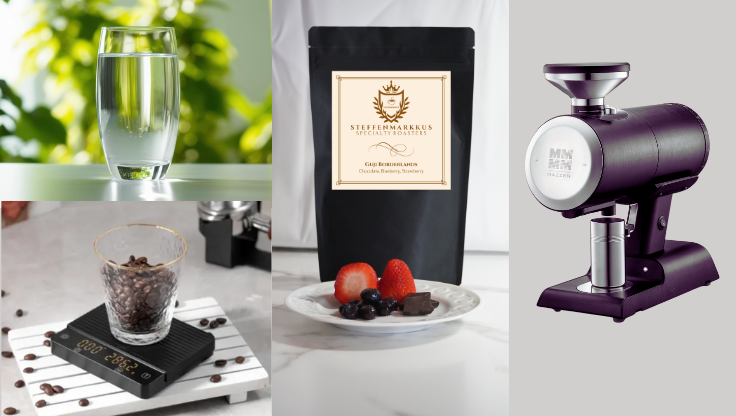
Four Tips for Better Coffee Brews
Share
Four things make home brewing easier to repeat: water, grind, dose and roast age. These tips apply to several brew methods and build on each other.
Tip 1: Use water that tastes good
Tap water can taste of chlorine, and distilled or deionized water tastes flat, which does not make great coffee either. Look for filtered water that has minerals added for taste. Remineralized reverse osmosis (RO) water is easy to find at the grocery store, and there is no need to go overboard. If you want to avoid plastic bottles, an under-sink RO and remineralization system or a carbon-filter pitcher such as a Brita also works. Replace filters and cartridges on the schedule in the maker's instructions.
A few options to consider:
Pre-filtered and remineralized water: Icelandic Glacial water
Point-of-use system: 6 Stage Alkaline Reverse Osmosis System
Point-of-use filter dispenser: ZeroWater
Tip 2: Use a burr grinder
Grinder quality has a large effect on flavor. Choose a burr grinder that suits your brew method and budget. Consistent, adjustable grinding matters more than price alone. If you drink pre-ground coffee today, even an inexpensive burr grinder is a big step up.
There are two kinds of burr grinder, flat and conical. In our experience, flat burrs tend to give more clarity and make individual flavors easier to pick out, while conical burrs tend to give a fuller body. Try both if you can.
Use your grinder to tune flavor. Coarser grinds reduce contact time between coffee and water, and finer grinds increase it. If the cup is sour, go finer. If it is bitter, go coarser. Our grind guide has starting settings for each brewer.
A few options to consider:
Low-cost manual grinder: Hario Mini Slim
Electric conical: Baratza Encore
Prosumer flat burr: Mahlkönig X54
Tip 3: Brew by weight, not volume
Scoops are inconsistent. Light roasts are denser than dark roasts, so the same scoop holds a different amount of coffee, and dark roasts need more volume to reach the same strength. Weighing your coffee removes that variable. For automatic and pour-over brews, start with 10 grams of coffee per 150 ml of water (about 5 fl oz). For espresso, start with 18 grams for a double shot. Then adjust up or down to your preferred strength, and use the grind setting to balance sweetness and bitterness. Our brewing by weight guide walks through it.
Low-cost gram scale: American Weigh Scales (AWS) Precision Pocket Scale
Mid-priced brew scale: Hario V60 Brew Scale
Premium espresso scale: Acaia Lunar
Tip 4: Start with fresh coffee
Our coffee is roasted to order and sent out the next day. You can brew it soon after it arrives, or rest it to suit your method and taste. Espresso, for example, is often rested for a few days. How long you rest it is up to you.
Ground coffee loses freshness quickly, so grind just before you brew if you can. If you only have pre-ground coffee, buy small amounts and use them quickly. Some people also freeze whole beans and thaw only what they need.
Coffees to try:
Single-origin coffees: SteffenMarkkus Single Origin Coffees
Blends for every brew type: SteffenMarkkus Blends